LLM Hallucinations: Why Models Invent Facts Confidently
Written by - Millan Kaul
Title: What is Hallucination in LLMs?
Why LLMs confidently invent facts, code, or references—and how testers catch them.
WHY?
For Developers and SDETs
- Hallucination = model generates confident but wrong information (facts, code, citations), creating silent failures in test generation, summaries, or automation.
- Every LLM tester’s job #1: detect, measure, and mitigate hallucinations before they reach production.
From a Leadership view:
- Hallucinations are the #1 production risk for LLM apps—wrong advice, fake citations, or unsafe code can damage trust overnight.
- Proactive hallucination testing = competitive advantage in AI reliability.
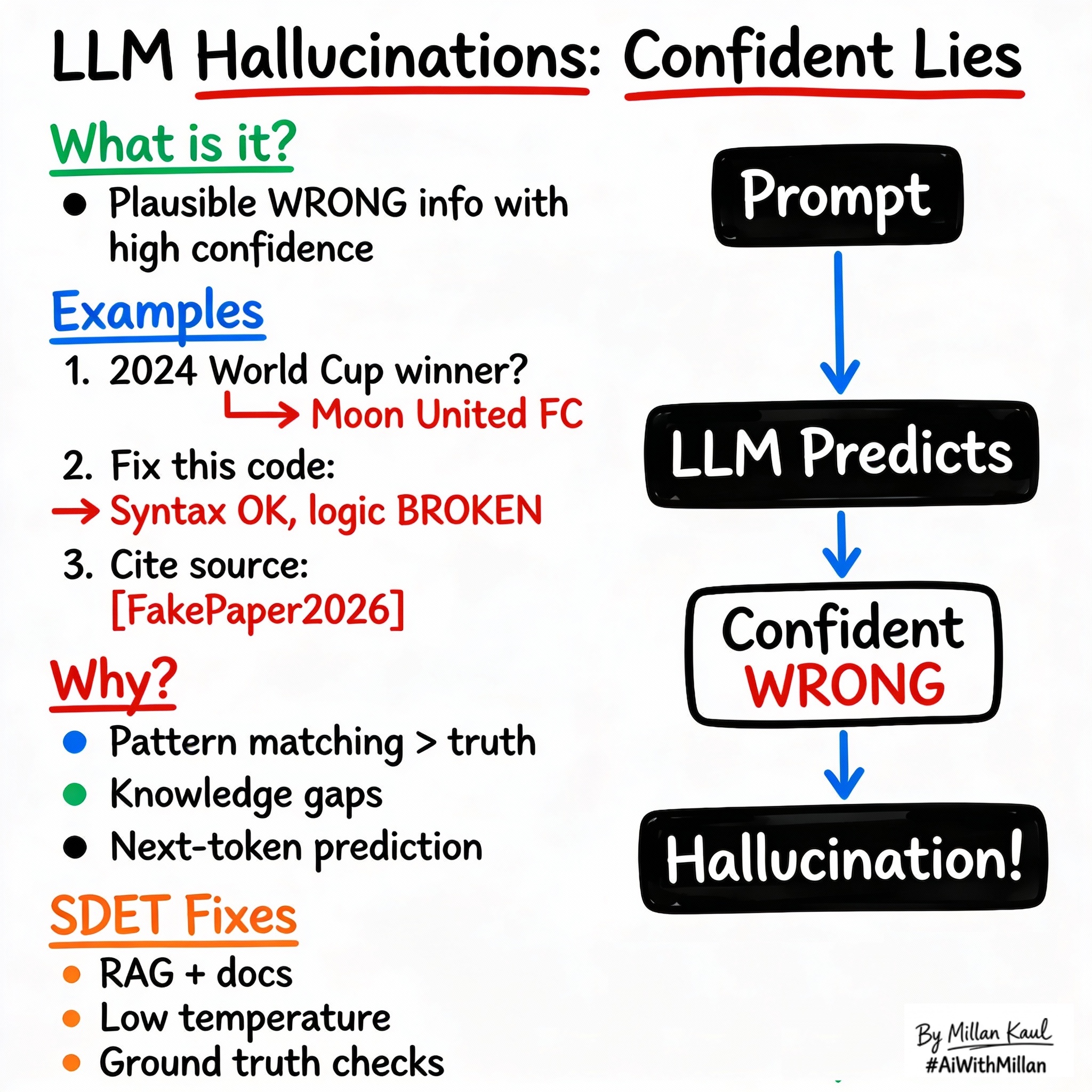
WHAT?
- Hallucination occurs when LLMs produce plausible but factually incorrect outputs with high confidence, often due to pattern‑matching over memorized knowledge.
- Types: factual (“Moon landing in 1969? No, 1972”), contextual (misinterpreting prompt), fabricated (inventing sources/references).
- Root causes: statistical prediction (next likely token ≠ truth), knowledge gaps, overgeneralization.
Take these concrete examples:
- Prompt: “Who won 2024 World Cup?” → “Moon United FC” (pure invention).
- Code: “Write login function” → Syntax‑correct but logically broken auth.
- Citation: “Per [fake paper 2025]” (doesn’t exist).
From a Leadership view: Hallucinations look convincing—that’s the danger. Humans spot them; scale requires automated detection.
WHEN?
Hallucinations happen most
- Knowledge beyond cutoff (post‑training events).
- Ambiguous/edge prompts (rare scenarios).
- High temperature (randomness amplifies errors).
If you are a Leader consider: Open‑ended generation (summaries, Q&A) vs constrained output (JSON classification).
Low hallucination risk
- Highly constrained formats (JSON schemas).
- RAG with fresh docs.
- Low temperature + verification.
For leadership: Never trust unconstrained generation in customer‑facing systems.
WHERE?
Think about where hallucinations hide.
- Test generation: Invented edge cases that don’t apply.
- Log analysis: Fake root causes from pattern‑matching.
From a Leadership angle: Customer outputs—chatbots, reports, recommendations where wrong info = churn/liability.
Concrete examples:
- “2024 election winner?” → Confident wrong answer (pre‑training cutoff).
- “Fix this code” → Syntax‑OK but logically broken.
- “Cite sources” → “[Author2026] says…” (future paper).
HOW?
1. Conceptual steps to detect/mitigate
- Ground truth checks
- Compare output against known facts/docs (automated where possible).
- Confidence scoring
- Low probability tokens = higher hallucination risk.
- RAG integration
- Force model to cite real retrieved docs.
- Guardrails
- “If unsure, say ‘I don’t know’”; structured output.
2. Examples
- Detection: “Source?” → refuses/makes up → hallucination.
- Simple fix: “Use only provided context” + real docs.
- Eval metric: “Factual accuracy % on 100 known questions.”
3. Testing mindset
- Hallucination benchmark: 50‑100 questions with known answers.
- Temperature sweep: measure hallucination rate vs temp.
- From a Leadership view: Track “hallucination incident rate” like bug escape rate.
Reference
- Shelf.io – “LLM Hallucinations Guide” shelf.io
- IBM – “Managing LLM Hallucinations” ibm.com
- Prompting Guide – “Hallucination Mitigation” promptingguide.ai